Showing posts with label abdominal pain. Show all posts

Tuesday, 2 July 2019

What is appendicitis ? | causes, symptoms, and treatment | 2019

APPENDICITIS

Hello everyone 

Today's blog is all about appendicitis. The appendix is a small pouch(finger shaped) situated at the lower right side of the abdomen( Right iliac region). The exact location of the appendix is at the junction of the small intestine and large intestine.
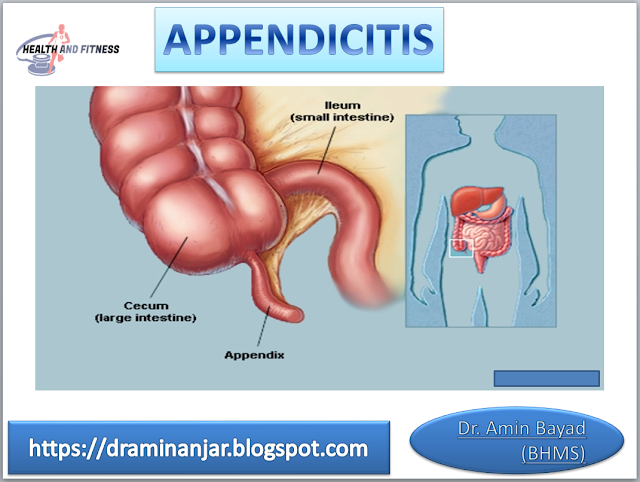


location of appendicitis


The function of the appendix is still in doubt that some scientists believe that appendix is the storehouse of good bacteria that release after the attack of diarrhea but some scientists say that there is no any function of the appendix and its useless part of our body.

Definition of Appendicitis 


Appendicitis is defined as inflammation of the appendix. One should always know that appendicitis is a medical emergency if untreated than it will burst or rupture and spread infection in the abdomen. This can lead to inflammation of the peritoneum(peritonitis)and that can be fatal and need emergency treatment with higher antibiotics.

CAUSES OF APPENDICITIS 


Thre exact define cause of appendicitis is unknown some scientists believe that there is an obstruction of appendix lead to form infection inside and become swollen and painful.

Obstruction of appendix leads to multiplying of bacteria and the formation of pus and swelling occur. So because of the formation of pus sever pain starts at the lower right abdomen.


SYMPTOMS OF APPENDICITIS 


Classical symptoms of appendicitis 
  1. Initially pain at the upper abdomen later pain shift to the lower abdomen and become severe.
  2. loss of appetite
  3. vomiting/nausea
  4. fever
  5. cramps
  6. constipation or diarrhea 


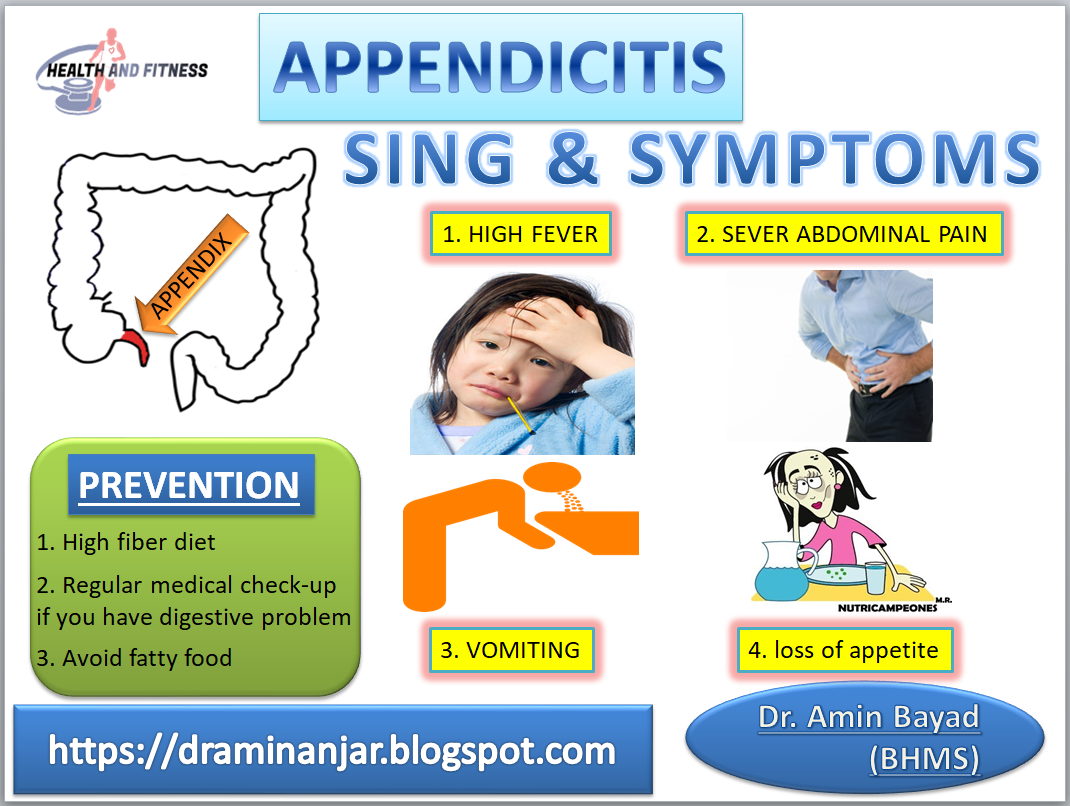
Symptoms, prevention, and location of appendicitis

DIAGNOSIS OF APPENDICITIS 


The abdomen has lots of organ in it and all are important for body function so, on the basis of abdominal pain, there is lots of reason or etiology are suspected there for diagnosis of appendicitis is tricky. Your doctor may advise below investigation to rule out the exact cause of abdominal pain.


  • Abdominal examination for tenderness and inflammation
  • Urine test
  • Rectal examination
  • Complete blood count
  • USG of abdomen 
  • CT-scan

DIFFERENTIAL DIAGNOSIS OF ABDOMEN

  1. Urinary tract infection
  2. Gastroenteritis
  3. Urolithiasis
  4. Ectopic pregnancy
  5. crohn's disease 

TREATMENT OF APPENDICITIS


Line of treatment is varying according to the severity of appendicitis. The physician may recommend the following line of treatment. 
  • Liquid diet
  • Analgesic
  • Antibiotics
  • IV- fluids
  • Needle drainage of abscess
  • Surgical removal of the appendix (Appendectomy) 

In most of the case of appendicitis, the physician advises for surgical removal of the appendix for safe side.

Appendectomy is the best option for appendicitis rather than antibiotics therapy. There are two types of the surgical procedure are available for an appendectomy.

1. Open surgery:- In this type of surgery surgeon can incise abdomen about 2 to 4 inch at McBurney's point to remove the appendix. 

2. Laparoscopic surgery:- In laparoscopic surgery surgeon can incise a few small opening in the abdomen and insert a very small robotic line with a camera and remove the appendix. This minimum invasive surgery can fasten the recovery so nowadays all the surgeon recommended laparoscopic surgery.

COMPLICATION OF APPENDICITIS


1. Peritonitis:- If untreated than appendix may rupture and releases the pus in the abdominal cavity, that leads to infection of peritoneum( peritonitis)

2. Perforation
3. Appendicular Abcsess
4. Surgical wound infection


DR. AMIN BAYAD
(BHMS)


Wednesday, 15 August 2018

Typhoid Fever | Symptoms, treatment, causes, and prevention

TYPHOID FEVER


DEFINITION: - Typhoid fever is a systemic infectious disease caused by the bacterium Salmonella enterica serotype Typhi also known as s. typhi. Salmonella enterica serotype paratyphi( s. paratyphi) A, B, C cause the clinically similar condition known as paratyphoid. Typhoid and paratyphoid fever collectively referred to as enteric fever.

The contagious nature of the disease and incriminated faecally contaminated water sources in transmission was described by William Budd in 1873.


EPIDEMIOLOGY

India the typhoid fever is a major public health problem because of poor sanitation, lack of safe drinking water supply and low socioeconomic condition. That’s why in India there is lots of case of typhoid fever. The typhoid fever is usually observed throughout the year.

Age group: - mainly affect children and young adults

Gender: - more common in a male. As female are chronic carriers.

Socioeconomic factor: - Typhoid fever is a disease of poverty and associated with inadequate sanitation facilities and unsafe water supplies.


MODE OF TRANSMISSION

Typhoid fever is transmitted by the fecal-oral route, via contaminated food and water. Occasionally health care workers can acquire the disease from infected patients.


AETIOPATHOLOGY

I have lots of information regarding this section but as our motto is to explain in easy understand so I will briefly explain how bacteria enter in our bloodstream and produce typhoid fever as below,

S. Typhi is ingested with food and water (both contaminated).

Passes through the stomach and invade gut epithelium

In the small intestine invade and translocate to an intestinal lymphoid follicle
 
Some pass on to reticuloendothelial cells of liver and spleen

In the liver and spleen, they multiply

After 7 to 14 days of incubation clinical conditions such as fever appear


CLINICAL FEATURES

Prolonged fever: - initially low grade, rises progressively, and by the second week is often high and sustained. Continues fever rising in step-ladder fashion is observed
Fever including chills, headache, anorexia, cough, weakness, sore throat, dizziness, muscle pain and abdominal pain.

There are some physical sing present in typhoid fever such as coated tongue, tender abdomen, hepatomegaly and/or splenomegaly may be found.


In some patient at the end of 1st week small maculopapular, blanching and erythematous rush typically on trunk and chest may be seen.

Constipation may present in some patient


DIAGNOSIS

Typhoid should be considered in any patient with prolonged unexplained fever with an appearance of a rose spot.
Complete blood count
Widal test is the best serological test to diagnose typhoid fever


COMPLICATION

The commonest complication is as follow
Intestinal perforation
Gastrointestinal hemorrhage
Typhoid encephalopathy


PROGNOSIS

When untreated the fever persists for 2 weeks or more and defervescence occurs slowly over the following 2 to 3 weeks. Death occurs in between 10% to 30%  of an untreated patient following complication.


PREVENTION

We can prevent typhoid fever by improving sanitation, ensuring the safety of food and water supplies, identification and treatment of chronic carries of s.typhi, and use of typhoid vaccines to reduce the susceptibility of the host to infection.

Vaccination is recommended for use in travelers to endemic areas, for household contact of typhoid carries, and laboratory workers.
There are two type of vaccine available for typhoid fever
1 Parenteral Vi polysaccharide vaccine.
2 Oral Vaccine ( S. Typhi strain Ty21a is live attenuated oral vaccine)


TREAMENT

General Management

Supportive measures such as adequate rest, tepid bath and sponging, appropriate nutrition and diet, all are important in the management of typhoid fever.

Anti-microbial therapy

There are many medicines to treat typhoid fever but without consultation with your family physician, you cannot use any antibiotics. If you have high-grade fever since 7 to 10 days without any relief in symptoms please consult your family physician for proper treatment


Dr. Amin I Bayad
(BHMS)